



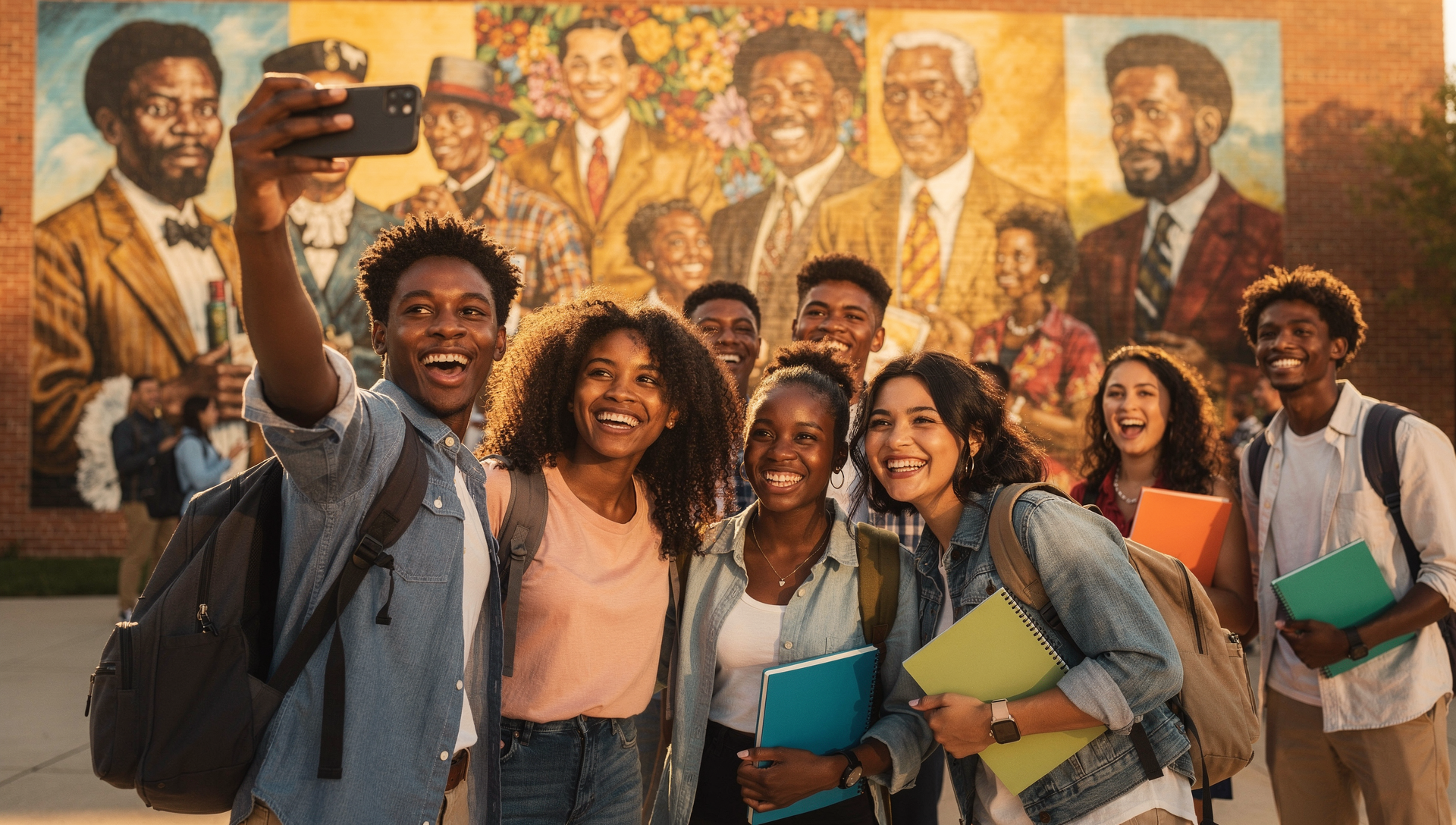
Hidden Figures on Campus: Black Educators Who Paved the Way
When we think of education pioneers, we often remember the famous names: Booker T. Washington, Mary McLeod Bethune, W.E.B. Du Bois. But for every well-known figure, there are hundreds of Black educators whose names never made it into history books—yet whose impact resonates through generations of students they taught, mentored, and inspired.
This Black History Month, DAAP is shining a light on both the historical and contemporary Black educators who’ve made excellence possible for students who look like us.
The Historical Pioneers We Should Know
Anna Julia Cooper: Scholar and Visionary
Born enslaved in 1858, Anna Julia Cooper became one of the most brilliant intellectuals of her time. She earned a PhD from the Sorbonne at age 65 and spent her career teaching at the M Street School in Washington, D.C. (now Dunbar High School), where she prepared Black students for college at a time when most Black Americans were denied basic education.
Her radical belief: Black women deserved the same rigorous education as anyone else. She refused to track her students into vocational programs and instead prepared them for university—despite enormous pressure to accept “separate but inferior.”
Her legacy today: The principle that Black students deserve excellence, not just access.
Fanny Jackson Coppin: The First Black Woman College Principal
In 1865, Fanny Jackson Coppin became the first Black woman to lead a major educational institution when she was appointed principal of the Institute for Colored Youth in Philadelphia. She created a teacher training program that produced hundreds of Black teachers who went on to educate thousands of Black students across the country.
Her radical belief: Education must include both classical academic training and practical skills—not one or the other.
Her legacy today: The holistic approach to education that prepares students for both intellectual leadership and practical success.
Charles Hamilton Houston: Training Civil Rights Lawyers
As dean of Howard University Law School, Charles Hamilton Houston transformed it into a training ground for civil rights attorneys. He taught Thurgood Marshall, mentored the lawyers who would argue Brown v. Board of Education, and built a pipeline of Black legal talent that dismantled Jim Crow.
His radical belief: Black lawyers could use the law as a tool to dismantle the legal system of oppression.
His legacy today: The understanding that education must prepare students not just to succeed within systems but to transform them.
Septima Clark: Teaching Freedom
Septima Clark created citizenship schools across the South that taught thousands of Black adults to read so they could pass literacy tests and vote. She understood that education and political power were inseparable—and that the classroom could be a site of revolutionary organizing.
Her radical belief: Literacy was a civil right and a tool for liberation.
Her legacy today: Education as a pathway to political empowerment, not just individual advancement.
Contemporary Black Educators Carrying the Torch
These historical figures inspire, but Black educators today continue their work—often under even more challenging circumstances.
Dr. Christopher Emdin: Making STEM Culturally Relevant
A professor at Teachers College, Columbia University, Dr. Emdin is revolutionizing STEM education by connecting it to hip-hop culture, showing that science and math can be taught in ways that honor students’ identities rather than erasing them.
His impact: Teachers trained in his methods report dramatic increases in engagement and achievement among Black students in STEM.
Dr. Gholdy Muhammad: Centering Black Literacies
Dr. Muhammad developed the Historically Responsive Literacy framework, which teaches educators to design curriculum that centers Black students’ identities, skills, intellect, and criticality—rather than treating white, middle-class literacy as the default.
Her impact: Schools implementing her framework see Black students not just improving test scores but developing genuine love for reading and writing.
The Unsung Teachers in Our Communities
Beyond famous educators are thousands of Black teachers showing up daily in under-resourced schools, seeing brilliance in students others overlook, and fighting systems that underestimate Black children.
Ms. Washington, a high school English teacher in Atlanta, stays after school tutoring students for free, attends their games and performances, writes college recommendation letters on her own time, and texts former students words of encouragement during finals week—every semester, for 22 years.
Mr. Brown, a middle school math teacher in Detroit, uses his own money to buy graphing calculators for students who can’t afford them, creates real-world problems that connect to students’ lives, and has helped 85% of his students pass the state math exam in a district where the average is 40%.
Professor Davis, one of only three Black professors in her department at a large state university, mentors every Black student who reaches out, advocates for policy changes that support students of color, and does the invisible labor of making campus feel less hostile—all while maintaining her research and teaching excellence.
These educators rarely receive recognition. They’re not training lawyers who’ll argue before the Supreme Court or students who’ll become famous scientists. But they’re changing lives, one student at a time.
Why Black Educators Matter: The Research
The impact of Black educators isn’t just anecdotal—it’s backed by research:
- Black students who have at least one Black teacher in elementary school are significantly more likely to graduate high school and attend college
- Black teachers have higher expectations for Black students than white teachers do, even when looking at the same students
- Black students report feeling more valued and understood in classes taught by Black teachers
- The “achievement gap” shrinks when Black students have Black teachers
This isn’t because white teachers can’t be excellent educators for Black students—many are. It’s because representation matters. When students see someone who looks like them in a position of authority and intellectual leadership, it expands their sense of possibility.
The Crisis: We’re Losing Black Educators
Despite their importance, the percentage of Black teachers is declining:
- Black students make up 15% of public school enrollment, but Black teachers are only 7% of the teaching workforce
- Black teachers face harsher working conditions, lower pay, and less support than their white colleagues
- Black teachers are more likely to be placed in the most challenging schools with the fewest resources
- Many leave the profession within their first five years
We’re losing Black educators right when we need them most. And when they leave, Black students lose not just teachers but mentors, advocates, and proof that someone who looks like them can lead a classroom.
What DAAP Is Doing
DAAP recognizes that supporting Black students means supporting the Black educators who guide them. That’s why we:
Mentor Future Educators
We connect education majors with experienced Black teachers and professors who can prepare them for the realities they’ll face and strategies for thriving despite challenges.
Provide Financial Support
Teaching doesn’t pay well, especially in the early years. We offer scholarships and emergency aid to education majors so financial stress doesn’t force them out of the profession.
Create Community
We bring Black educators together—from pre-service teachers to veteran professors—to share strategies, provide mutual support, and remind each other why this work matters.
Advocate for Systemic Change
We push schools and universities to recruit, support, and retain Black educators—and to pay them fairly for the crucial work they do.
How to Honor Black Educators This Month
For Students:
- Thank a Black educator who impacted you. Write them a note, send an email, or visit if you can. Tell them specifically how they changed your trajectory.
- Amplify their work. Share their research, promote their classes, and recommend them to other students.
- Support them publicly. When Black educators face criticism or pushback for teaching truth, stand with them.
For Schools and Universities:
- Recruit aggressively. Diversifying your educator workforce should be a priority, not an afterthought.
- Support fully. Black educators shouldn’t have to do all the diversity work while maintaining the same research and teaching expectations as everyone else.
- Pay fairly. Compensation should reflect the value and additional labor Black educators provide.
- Promote equitably. Black educators deserve leadership positions and tenure at the same rates as their colleagues.
For Everyone:
- Support future Black educators. Donate to DAAP’s scholarships for education majors.
- Value teaching. Push for higher teacher pay, better working conditions, and more respect for the profession.
- Challenge deficit narratives. When people blame teachers for educational inequity, redirect to systemic issues and inadequate funding.
The Future We’re Building
Every time a Black student succeeds academically, there’s likely a Black educator who believed in them, saw their potential, demanded their excellence, and refused to accept less than their best.
These educators—historical and contemporary, famous and unknown—are the hidden figures who make visible achievement possible.
This Black History Month, let’s commit to ensuring that future generations have even more Black educators than we did. Let’s invest in the teachers who’ll shape tomorrow’s leaders. Let’s honor not just the educators of the past but the ones showing up today.
Because behind every Black student who makes history is a Black educator who believed they could.
Support the next generation of Black educators through DAAP’s scholarship and mentorship programs. Visit [website] to donate, volunteer, or learn more about how we’re building the future of Black education.